Publication of ISA 2026 Contributions in the Peer Community Journal (PCJ) through PCI Archaeology
Who Can Submit?
Submission is open to all authors presenting a contribution at ISA 2026, including both oral and poster presentations.
Authors may submit one manuscript for each contribution accepted for presentation at the conference.
The submitted manuscript must be clearly related to the research presented at ISA 2026, although it does not need to reproduce the presentation exactly. Authors may expand, refine, or further develop specific aspects of their work.
From Submission to Publication: A Step-by-Step Guide
The papers will go through the process outlined here and graphically depicted in the following diagram:
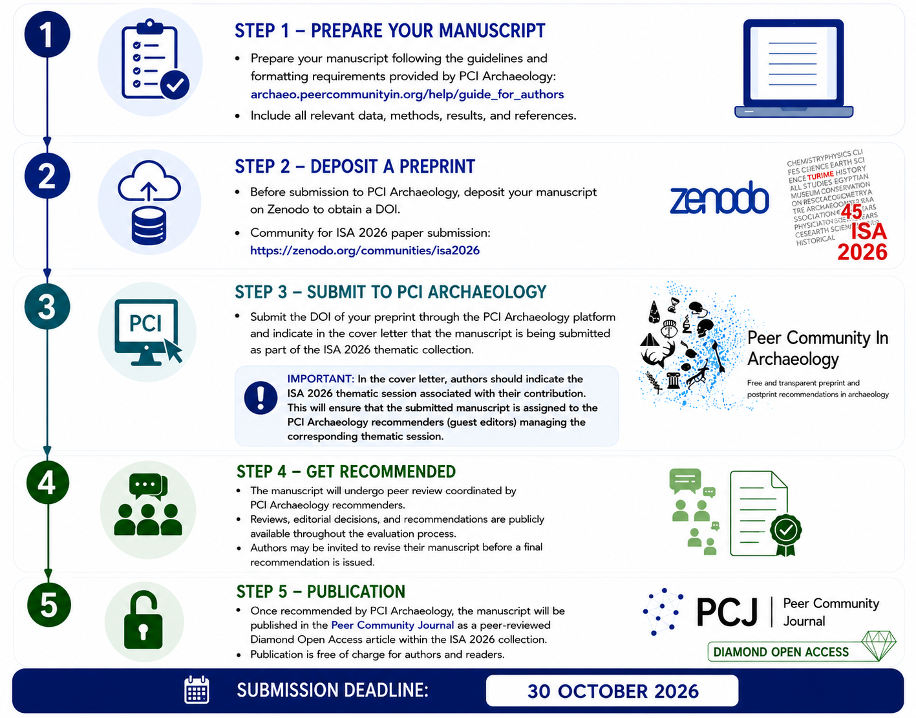
Step 1 – Prepare Your Manuscript
Authors should prepare a complete manuscript following the guidelines and formatting requirements provided by PCI Archaeology: https://archaeo.peercommunityin.org/help/guide_for_authors
The manuscript should present original research and include all relevant data, methods, results, and references.
Step 2 – Deposit the Preprint
Authors must obtain a DOI by depositing their manuscript in the ISA 2026 community on Zenodo https://zenodo.org/communities/isa2026.
IMPORTANT: A Zenodo account is required to deposit a manuscript. If you do not already have one, please create it before starting the submission process.
Whenever possible, associated datasets, code, images, analytical workflows, and supplementary materials should also be deposited in the open repository, unless ethical, legal, cultural heritage, or confidentiality considerations prevent open sharing.
Step 3 – Submit to PCI Archaeology
Submit the DOI of your preprint through the PCI Archaeology platform and indicate in the cover letter that the manuscript is being submitted as part of the ISA 2026 thematic collection.
IMPORTANT: In the cover letter, authors should indicate the ISA 2026 thematic session associated with their contribution. This will ensure that the submitted manuscript is assigned to the PCI Archaeology recommenders (guest editors) managing the corresponding thematic session.
Step 4 – Get Recommended
The manuscript will undergo open peer review coordinated by PCI Archaeology recommenders. Reviews, editorial decisions, and recommendations are publicly available, ensuring transparency and accountability throughout the evaluation process.
Authors may be invited to revise their manuscript before a final recommendation is issued.
Step 5 – Publication
Once recommended by PCI Archaeology, the manuscript will be published in the Peer Community Journal as a peer-reviewed Diamond Open Access article within the ISA 2026 collection.
Publication is free of charge for authors and readers.
SUBMISSION DEADLINE: 30 October 2026

FAQ
- Does presenting at ISA 2026 increase the chances of publication?
Presenting at ISA 2026 provides a scientific context and a thematic framework, but publication decisions are entirely independent. Each manuscript is evaluated on its own merits through open peer review within PCI Archaeology.
- Who manages the peer-review process?
Peer review is coordinated by appointed recommenders (equivalent to associate editors), selected among recognised scholars and aligned with the thematic areas of the conference. Reviews are public, reasoned, and signed, ensuring transparency and accountability.
- How does this differ from submitting directly to a journal?
In this model, scientific evaluation comes first and is fully transparent, while publication follows only after a positive recommendation.
- Is this model appropriate for highly technical or laboratory-based studies?
Yes. The PCI model is particularly suitable for research involving analytical methods, diagnostic data, and complex interpretation, where documenting uncertainty, limits, and methodological choices is essential.
- How is this publication pathway evaluated in terms of academic recognition?
Articles are published in the Peer Community Journal, a Diamond Open-Access journal indexed in both Web of Science (Impact Factor 2024: 2.0) and Scopus (CiteScore 2024: 2.5). At the same time, the model aligns with responsible research assessment principles, valuing transparency and quality over metric optimisation.
- Can poster presenters submit a manuscript to PCI Archaeology?
Yes. Submission is open to both poster and oral presenters at ISA 2026. Authors may submit one manuscript for each contribution.
- Does the manuscript need to correspond exactly to the poster or oral presentation?
The manuscript must be clearly related to your ISA 2026 contribution, but does not need to be identical. You may explore a specific aspect in more detail or broaden the scope, as long as it remains directly connected to the conference research.
- How many manuscripts can an author submit?
Authors may submit one manuscript per contribution presented at ISA 2026, whether poster or oral. Each submission will be independently evaluated through the PCI Archaeology open peer-review process.